Call for Papers
APSCE International Conference on
Learning Evidence and Analytics (ICLEA) 2027
Overview
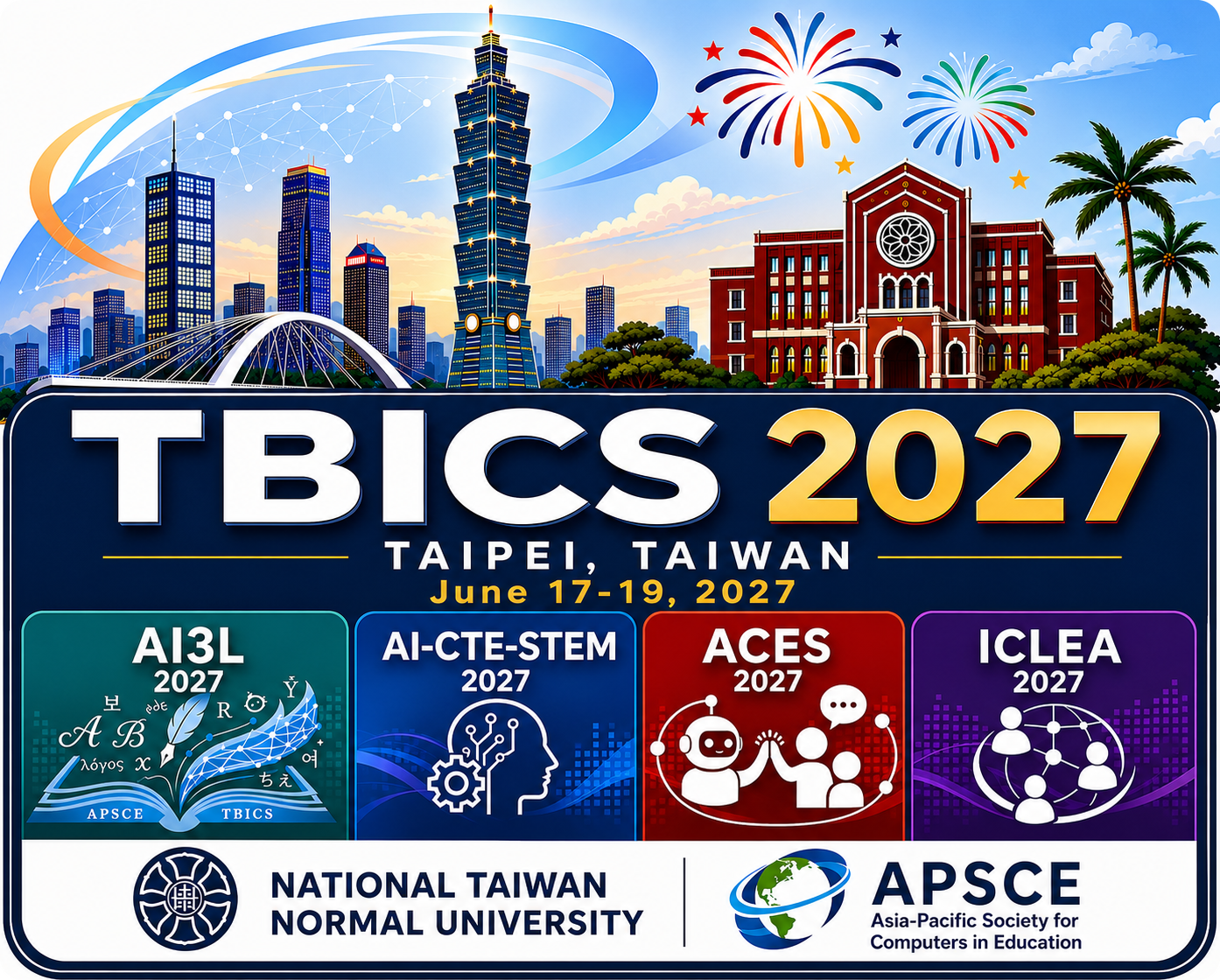
The 3rd International Conference on Learning Evidence and Analytics (ICLEA 2027) will take place on June 17-19, 2027, at National Taiwan Normal University.
This year’s theme, “Revitalizing Educational Data and Evidence through Generative AI,” underscores the evolving value of educational data, focusing on how generative AI can transform fragmented, underused records into contextualized, generative, and actionable evidence. As generative AI increasingly permeates learning environments, ICLEA 2027 invites us to explore how educational data can be interpreted, connected, and reimagined to reveal new understandings of learning and catalyze more responsive, discerning, and human-centered decision-making for learners, educators, and institutions.
ICLEA2027 aims to bring together global researchers, educators, policymakers, and industry experts to share and discuss the latest research and trends in learning evidence and analytics. ICLEA provides a dedicated forum for examining how the rise of generative AI is reshaping the educational data landscape, including what counts as evidence, how it is produced, and whose perspectives it represents. Rather than centering on the development of generative AI itself, ICLEA 2027 foregrounds the methodological, ethical, and pedagogical conditions needed to translate increasingly complex data ecosystems into credible knowledge and sustained educational improvement.
Topics of Interest
We invite submissions that address cutting-edge research, case studies, best practices, and emerging trends in the following topics (but not limited to these). Submissions focused solely on generative AI should demonstrate a substantive connection to learning evidence, learning analytics, or educational data.
Educational data infrastructures, interoperability, and standardization
- Architectures, platforms, and standards for collecting, integrating, and managing educational data
- Data quality, provenance, interoperability, and lifecycle management across learning systems
Educational data analytics and visualization
- Methods for modeling and interpreting cognitive, behavioral, affective, social, and metacognitive learning processes
- Visual, explainable, and AI-assisted interfaces for interpreting and communicating learning evidence
Learning analytics practice and educator professional development
- Integration of learning analytics into teaching, reflection, planning, and intervention
- Educator competencies for interpreting and applying learning analytics and AI-generated analyses of educational data
Learning analytics in higher education
- Course-, program-, and institution-level applications of learning analytics
- Analytics for student engagement, progression, retention, curriculum improvement, and well-being
Special education, inclusion, and personalized learning
- Data-informed personalization and analytics-based support for diverse learning needs
- Inclusive, accessible, and fair design of learning analytics and data-informed adaptive systems
Policy, governance, and responsible use of educational data
- Governance of educational data access, ownership, privacy, consent, transparency, and accountability
- Validation and oversight of AI-assisted methods for analyzing and interpreting educational data
International and cross-institutional educational data collaboration
- Cross-border and cross-institutional sharing and analysis of educational data
- Technical, legal, ethical, and cultural frameworks for collaborative learning analytics
Proceedings & Journals
Accepted papers in the main conference will be published in the proceedings of the APSCE Library.
Authors of selected accepted papers may be invited to submit extended versions for possible inclusion in a special issue of [journal name], subject to journal approval. Details regarding the submission process will be shared at a later date.
Important Dates
Please see the Submission & Important Dates page for deadlines and registration details.
Conference Chairs
Conference Chair

Tosti Chiang
National Taiwan Normal University, Taiwan
Program Chair

Changhao Liang
Kyushu University, Japan
Program Co-Chair

Chia-yu Hsu
Kyoto University, Japan
Program Co-Chair

Chris Yang
National Taipei University of Education, Taiwan
Program Co-Chair

Xiao Hu
University of Arizona, USA
Local Chair

Liang-Yi Li
National Taiwan Normal University, Taiwan
Advisors
Advisor

Elizabeth Koh
Nanyang Technology University, Singapore
Advisor

Rwitajit Majumdar
Kumamoto University, Japan
Advisor

Atsushi Shimada
Kyushu University, Japan
Questions about ICLEA 2027?
For program or submission queries, email the ICLEA 2027 team.